Out with the old and in with the new
We’re into a new year and, if you take a look outside, chances are you might see evidence of newness in the natural world as well. Snowdrops – one of the earliest indications that spring is on the way – are already out in force. And in places daffodils are springing up ready to flower when their time comes.
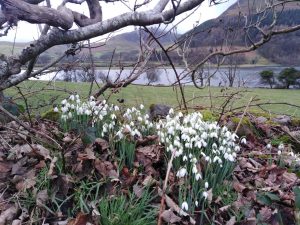
There will be anticipated new life – the snowdrops and daffodils themselves examples of a reliable cycle which we can expect to see come to fruition year in, year out.
Woodland scenery is, overall, still looking quite bare, as deciduous trees wait patiently for their latest covering of leaves to burst from their branches. But they know their greenery will not be far away.
The will also be fresh newness of life. Seeds dropped by birds and animals, or carried on the wind, which then became buried in an unexpected soil will begin to take root then, when the time is right, shoot up from the ground, bringing a plant the owner of the land had not anticipated. Some such plants will be welcomed, others uprooted to prevent them having a negative impact on the landscape.
Some things will need pruning by the gardener to enable them to reach their full potential this season, with dead wood and the remains of last years flower pruned away to enable the sap’s goodness to focus on areas of fresh growth.
And, amid all the fresh life, there will be some things that, this year, so not spring forth. Plants that have not survived the winter will sit, dead and bare, waiting for the gardener to uproot them and make space for fresh life. Plants that have burst into life and bloom year in, year out might find that this is the year when flowers are not forthcoming. The tree that has stood tall for decade after decade might find that this is the winter when it cannot weather the storm and is instead uprooted by the wind.
Newness can only come when the right conditions are provided. The germinating seed required warmth and damp. Growing shoots need water and light for nourishment.
In the Bible, John chapter 15 tells of God’s work as a gardener, pruning and cutting away to make the plants of His metaphorical garden – His people – as fruitful as they can be. The chapter, in verses one to eight, shows Jesus saying, “I am the true vine, and my Father is the gardener. He cuts off every branch in me that bears no fruit, while every branch that does bear fruit he prunes so that it will be even more fruitful. You are already clean because of the word I have spoken to you. Remain in me, as I also remain in you. No branch can bear fruit by itself; it must remain in the vine. Neither can you bear fruit unless you remain in me.
“I am the vine; you are the branches. If you remain in me and I in you, you will bear much fruit; apart from me you can do nothing. If you do not remain in me, you are like a branch that is thrown away and withers; such branches are picked up, thrown into the fire and burned. If you remain in me and my words remain in you, ask whatever you wish, and it will be done for you. This is to my Father’s glory, that you bear much fruit, showing yourselves to be my disciples.
Throughout nature, and throughout life, change is inevitable. Seasons change, life changes, people change. That which flourished in previous seasons or years may be the same thing that now, in this season, needs to be uprooted. That which once produced beautiful blooms might find the time has now come for it to make way for a fresh plant, a new creation, a different beauty.
Each tree, each plant, each flower is beautiful and purposeful in its time, but for each that time must and will come to an end.
One thing is for certain: We must be careful not to get so hung up on the loss of one daffodil that was uprooted this year that we risk failing to notice a whole garden of fragrant roses that have been planted in its place.
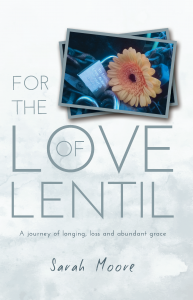 Sarah Moore is the author of For the Love of Lentil, A journey of longing, loss and abundant grace, which tells the story of her experience of pregnancy and miscarriage. Copies of the book are available here.
How lovely, Sarah; I thought about this as I walked Holly along lanes, through fields and by the river. Thanks.