When life gives you lemons, write a book about lemons
Today I celebrated the dispatch of the first set of book orders by going clothes shopping. Okay, that’s not entirely accurate. I actually went clothes shopping because the heatwave is showing no signs of subsiding and approximately 0.02% of the contents of my wardrobe were suitable for wearing in this heat without the risk of collapsing from heat exhaustion inside half an hour. I did go after I’d dropped off the orders at the post office, though, so it was kind of a celebration of no longer having a heavy bag of post to carry.
So I went to a shop, which seemed like the best place to go when shopping, gathered armfuls of summery dresses and headed for the changing rooms. I’m not normally a dressy person but needs must. I’m also rarely seen not in black and most of the dresses I tried on weren’t black. “Wow,” I realised, “I really am branching out into new things these days.” I was right. Publish a book one week, wear an outfit entirely devoid of the colour black the next. Who knows where my new adventurous streak will end?
The pattern of one of my new dresses is lemons. “An unsual design choice,” I thought as I tried it on. I don’t know, maybe lemons are the new pineapples – the unicorn craze of the fruit world. Then the pattern got me thinking. We’ve all, I’m sure, come across the phrase, “When life gives you lemons, make lemonade.” It is, of course, an encouragement to emphasise the positive in all situations rather than a call to indulge in fruity drinks – a reminder that something sweet can come out of even the bitterest of things. I decided to adapt the phrase a bit: When life gives you lemons, write a book about lemons.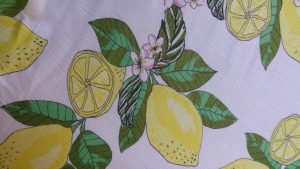
Don’t panic, I don’t mean it literally. I’m not going to pester you to buy a new book every time I run out of milk, step in cat sick on the landing or go to the fridge to get my last chocolate bar only to find that my husband has eaten it (actually, that last one’s unlikely to happen as I’m pretty sure he learned the error of that particular way the first and last time he did it).
No, it doesn’t have to be an actual book. It’s more about grabbing hold of ever lemony experience – the pain, the sharpness, the bitterness of life – drawing from it the sweet nectar that lurks within, however well hidden it might be, and sharing that experience so other people can see the good as well as the bad. For some people and in some cases that might be through a book, in others through a blog or social media, for some simply through having a conversation with someone. What matters, as I see it, is that we allow something positive to come out of each negative. Sometimes it might be easier said than done. Sometimes the positive can be small and the dark cloud so much bigger. Sometimes it can be hard to find a positive at all. But when we do, if we grip tightly to it, the results can be so much greater than if we allow ourselves to be gripped by the darkness and the bitterness.
And I say “write a book about lemons” rather than “about lemonade” because the lemons are important. The lemons are the context. They’re the television screen through which we view our lives and draw on our experiences. They are where our story begins and the setting in which the lemonade of our lives is brewed.
A quick flick through the Bible reveals so many time when it would have been understandable for people to allow themselves to be consumed by their difficult circumstances. Acts chapter five tells of the apostles being persecuted, jailed and flogged. I reckon they could have been forgiven for feeling a bit down in the dumps about life and wanting to throw in the towel and call time on their ministry. What they actually did was rejoice that they had been considered worthy of suffering. Let’s just take a moment to take that in. They rejoiced that they had been considered worthy of suffering. And then they carried on proclaiming the good news of Jesus, perhaps with greater enthusiasm than before because of the trials they had overcome. That’s definite lemonade sharing.
It’s easy to forget the tough time that Mary, the mother of Jesus, would have had in her circumstances. She was an unmarried mother-to-be at a time when being pregnant outside marriage brought shame. She would have been faced with the task of convincing her fiancé Joseph she hadn’t been unfaithful to him. We might expect her to be a bit miffed at God for overshadowing her wedding plans with the bombshell that was Jesus. What did she actually do? According to Luke 1:46-47 she said, “My soul glorifies the Lord and my spirit rejoices in God my saviour…” She was definitely focusing on the lemonade rather than the lemons.
And Jesus himself, as he was hung upon the cruel cross, had suffered so greatly that he called out to the Lord, “My God, my God, why have you forsaken me?” (Matthew 27:46) He was Jesus. He had all power. He could have said, “You know what, God, I’ve had my fill of this suffering. I think I’ll get down now, smite these accusers from the earth to teach everyone a lesson and get on with my day.” But He didn’t. He endured the lemons of earthly suffering with His eyes and heart fixed firmly on creating the lemonade of our salvation by dying in our place so we could be cleansed of our sins and made fit for Paradise. That’s quite a bitter pill – or rather cup – to swallow and yet one which has brought and continues to bring such cause for celebration.
And all these people’s stories remain powerful today because of the very fact they have been told and continue to be told.
May we never stop sharing the lemonade of our lives.
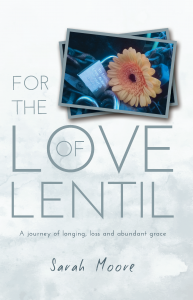 Sarah Moore is the author of For the Love of Lentil, A journey of longing, loss and abundant grace, which tells the story of her experience of pregnancy and miscarriage. Copies of the book are available here.
Beautifully written.
A continuation and development of an ongoing story, and a reason why many people need to read this book.