The challenges of navigating pregnancy after loss
October has arrived which means baby loss awareness is very much on the agenda so it seemed a good time to explore the minefield that is pregnancy after loss and perhaps dispel some myths around it – and to explore how faith and fear can operate in tandem during what can seem the longest and most unknown months.
 You see, when we announced our second pregnancy, there were those who saw it as the end of our baby loss journey. We’d lost our first baby but now we were having another one. Problem solved, move along please.
Let’s get one thing straight; the “problem” was not solved.
Without our precious first child in our arms, it would never be solved, and navigating pregnancy after loss can be a minefield. You want to celebrate but you don’t want to speak too soon.
When we had learnt of our first pregnancy we had been excited, full of expectation. With our hopes and dreams so quickly ripped from our grasp on that occasion, feeling that same excitement second time around was a challenge. There was excitement, undoubtedly, but it was muted, covered with a veil of what ifs. We knew God’s plan for our first pregnancy hadn’t matched ours. We hoped this time would be different but we had to be realistic about the fact that it might not be and we had no way of knowing.
We could pray that God would keep our child alive and bring her safely to birth. We could hope for it. But our faith was not for that; it was simply for the fact that we knew God’s plan was perfect and He wouldn’t lead us into anything we couldn’t navigate.
We had every faith that God would grant us a child in time but we didn’t and couldn’t have a certain faith that it would be this time and with this baby.
Every scan brought a level of trepidation (and we had six scans between seven and 40 weeks). Having learned of the loss of our first child through a scan that showed no heartbeat, it was impossible to avoid the “What if?” on the way to each one – especially those that came before we had started to feel the baby move.
Between scans in the early days the days and weeks felt so long. Okay, there was a heartbwat yesterday at the scan but that’s no guarantee there’s a heartbeat now, and we’ve got another 13 days until we find out.
The same applied at every midwife appointment as they checked the heartbeat. Each time, our own hearts were in our mouths as we hoped and prayed we would hear that reassuring rhythm. But still the underlying fear did not go away. Hearing a heartbeat today didn’t guarantee it would be there tomorrow.
We were asked at the start of the anomaly scan whether we wanted to know the sex of the baby. I can’t even remember which of us responded with, “Right now, we just want to know if it’s alive.” Either way, the words spoke truly for both of us. By then we still hadn’t definitively felt the baby move.
Sharing the news of our pregnancy once we’d reached 12 weeks brought its own challenges. Other people’s excitement crowded in. The fragility of the life in my womb was never far from the forefront of my mind but we didn’t want to quell other people’s excitement. How could we respond to people telling us how much they were looking forward to cuddles by highlighting that we didn’t know whether we’d get that far. We simply couldn’t. So we didn’t. And so we fed the taboo.
As time moved on the risk of miscarriage reduced but we knew it remained a risk nonetheless. I found myself targeting the “magic” 24-week mark, not because that brought a guarantee of a successful pregnancy but because of I was going to lose this baby I wanted her to be stillborn not miscarried. It seems illogical. To lose a baby is to lose a baby. Yet there are often unspoken hierarchies within baby loss, and the law treats bereaved parents differently in each case.
Once past the 24-week mark and began to feel the baby move things felt more reassuring but we knew stillbirth was still a possibility. And we knew that, so often, stillbirth occurred in seemingly healthy babies for no identifiable reason.
I found myself seeking to savour every movement my baby made in case it was the last. I wanted to be confident that we would end up with a healthy baby, and we planned for it, buying a pram, car seat, furniture… But at the same time we knew there were no guarantees, and I still couldn’t imagine actually holding our child in my arms. It felt as though, if I allowed myself to get too excited about our impending arrival, she might be ripped from my grasp. So I nodded politely whenever people talked about how I was going to be a mum, keeping to a minimum the occasions when I added a “hopefully” to proceedings.
I had no doubt that one day I would hold a child of my own in my arms. I was certain God had promised me that. What He had never promised was that that child would necessarily be this one. If I tried to convince myself it would without evidence, would I set myself up for an extra hard, extra painful fall?
That’s not to say we weren’t excited about our impending arrival. We were. We looked forward to the prospect of welcoming our child into the world, of dressing her in the outfits we’d accumulated, of lying in bed with her in the crib next to us. But even as we set up that crib in the weeks before her arrival, it was with prayer that we wouldn’t end up packing it away unused.
I don’t want anyone to think that the fear of losing our baby dominated our pregnancy. There was plenty of joy, plenty of expectation, plenty of hopeful, faithful preparation. But at the same time, the backdrop of loss was ever present.
From the day we found out we were expecting to the day she was born there were two days when the “What if?” question didn’t go through my head. They were her due date and the day after – the two days before the day of her birth. I don’t know why those days were different.
 The sense of joy and relief we experienced the moment Charlotte was born and let out her first heartwarming cry were palpable. We’d made it through pregnancy. She’d made it through pregnancy. Now we just had to hope and pray she would make it through infanthood, through childhood and beyond.
There are still times when she’s asleep and I find myself peering closely into her crib or pram or nudging her to confirm that she’s still breathing, but then I imagine every new parent does that to some extent.
But we are reassured that our prayer – for God to grant us a baby who we would bring to birth and nurture through life – has been answered, so far, in part. My faith that Charlotte is the rainbow we prayed for in the storm has grown with her healthy arrival into the world but still I know her future is ultimately not in my hands.
As the Bible quote on her nursery wall from Jeremiah chapter 29, verse 11 says, “‘For I know the plans I have for you,’ declares the Lord, ‘plans to prosper you and not to harm you, plans to give you a hope and a future.'”
My job now is to look after Charlotte the best I can and nurture her to find the path in life that God has planned for her, wherever that may take her, while hoping it involves a long, healthy and blessed earthly life. And that will always be in the context of what has gone before.
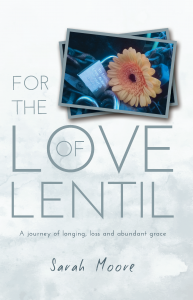 Sarah Moore is the author of For the Love of Lentil, A journey of longing, loss and abundant grace, which tells the story of her experience of pregnancy and miscarriage. Copies of the book are available here.
Oh Sarah, how I remember those feelings from when I was pregnant with Mel, having lost our previous baby. Admittedly we had already been fortunate enough to have a toddler by then, but the loss of our second baby was no less because of that, but the third pregnancy was a time when we feared getting too excited in case it happened again. Thank you for sharing so frankly your feelings throughout the pregnancy, there must have been times when you didn’t want to in case anything went wrong. So pleased that Charlotte arrived safely and is progressing well. Mum. xx